Tuesday, 4 February 2014

We have moved!

Now that our new website has been up and running for a couple of weeks, we have made a decision that it’s time to move to new pastures ... with a little bit of help from our friends.


Click here to go to our new blog site, where you’ll be able to set up an account which will keep you informed of new posts.

BTW we would like to thank Blogger for the opportunity to use their facility, which we would warmly recommend to anyone who wants to set up a blog site.

Wednesday, 22 January 2014

Using mental routines & challenging traditional approaches

On Monday, I worked with 130 teachers at Golden Grove in Adelaide. The first part of the day was spent trying out mental routines and the way in which they can be used to develop mathematical vocabulary and deep understanding through reasoning.

The 100 square mental routine allowed us to explore ways in which such a simple tool can allow for differentiation during a mental routine and game like situation.

Using the analogue clock allowed for discussion about how traditional approaches to teaching how to tell the time actually impedes progress.

The teachers who gave up a day of their holiday to be there yesterday were terrific to work with so thanks for the great day!


Tuesday, 21 January 2014

Early years workshop in SA

Hats off to South Australian teachers especially those from Port Noaralunga and surrounds who turned up on their holidays for a day of maths.

The focus was early years, and in the photo below, you can see teachers putting their solution to the muffins problem on the board ready to share and reflect. The teachers were asked to second guess what strategies the year 2 students might use for this unfamiliar problem. The problem is designed to find out what the students already now and can practice prior to actually teaching multiplication. The range of samples was very representative of what I see when I run this problem in classrooms - many rich and meaningful discussions followed.

As always it is a delight to be back in SA.

The story of the problem was:
The canteen workers needed to make 12 muffins with 6 m&ms on each muffin. They needed to buy the m&ms. How many m&ms did they need to buy?

Try it and see what your class understands about early multiplicative thinking.

Enjoy!


Friday, 17 January 2014

Schools Clean Up Day: Friday 28th February 2014

We all know students learn better when we can help them to make connections between in school activities and out of school current events. So let’s live greener by participating fully in Clean Up Australia Day.

A free kit with plenty of lesson plans and ideas is available for free at the Clean Up for Schools website.

There is plenty of stimulus for connected maths and science to be found at this site.

Way back in 1991 Johnny and I wrote a book called Counting on a Small Planet.

We were then and still are committed to doing whatever we can to preserve our environment. One section of the book was called ‘What’s in a Lunch Box’ and we have included a segment from it below. We used a real problem solving model with the class who worked over a period of several days on this problem.

What was not included in the book was the fact that this particular class decided to host a no rubbish morning tea for their parents. They discovered that in the ‘old days’ people took their lunch to school or work wrapped in handkerchiefs or tea towels and that workers took their own tea and coffee in a flask with their own cup.

They also discovered that Cornish pasties had sweet at one end and savoury in the middle and that the pastry was its own container. A lot of planning, problem solving and mathematics went into the morning tea. What a great way to raise parent’s awareness and for them to see how passionate their children were about the ‘rubbish’ issue.

With the event happening in February, it's never too early to start thinking about what else we can do to help children gain a better understanding of environmentally friendly practices that also tie in with learning, in particular maths learning.


Monday, 13 January 2014

Place Value to 100 will be available next week

Working in classrooms, we often notice areas that cause students particular difficulty. One of those areas is place value. We meet students even in Grade 4 who are doing 2-digit and 3-digit additions and, when asked, cannot read the answer correctly, nor do they have any idea if their answer is in the ball park.

Recently a Grade 4 boy was solving a problem using dots as counters, he got to 69 looked up and asked, ‘What comes after 69?’. When prompted, he continued the pattern until he reached 79, and then looked up for help again. Similarly when trying to teach students to use number splitting for value-based computations we meet students who know that the 2 in 27 means 20 but think that the 1 in 12 is just 1 not 10.

Clearly we are moving forward too fast with place value. Much research is suggesting that place value is an issue even in Grade 7.

So what goes wrong?

That was the question that we have been grappling with for quite some time. If students cannot actually count and count on in different patterns, how can they understand the role of digits in 2-digit and 3-digit numbers?

If they have not had experiences making single digit numbers in lots of different ways, how can they then understand that a number such as 36 can be made with three 10s and six 1s or with two 10s and sixteen 1s.

Difficulty with teen numbers is known to persist into Grade 4 - why then have we not paid more attention to developing deep understanding of teen numbers? Why do we rush when 'slowly slowly' wins the race?

The new package focuses on purposeful counting; understanding the magnitude of numbers to 100; sequencing numbers proportionally on an empty number line and solving problems requiring that numbers be grappled with, pulled apart put back together in many ways. Quantification and number sense are the driving forces used to build deep understanding of place value.

We hope you enjoy the package. Watch out over the next few days as videos of the place value games will be released.


Have a great year. Week Zero in South Australia next week and we are really excited to be in Adelaide next week working with teachers and yes you guessed it, showing off our new resources.

Monday, 6 January 2014

3D blocks for mental routines

Like everybody else, we are tidying up and planning for next year. As we did so, we came across the following email from Ann Paine. We don’t know how we missed it earlier but we thought we would post it so that you can get inspired by her 3D objects set too.

Hi Ann,
After your Spacial Awareness training session, I was inspired to make up these 3D Objects Mental Routine kits. One of the parents at my school made the cones using plasticine. I made the pyramids from card. My class enjoyed using the kits. As usual, they love to guess my 3D object at the end of the mental routine.
Feel free to share this idea.
Anna Pain
Light Pass Primary School.


EngQuest new in 2014

STEM Education (Science, Technology, Engineering, Mathematics) is gaining ground in schools. Many future jobs, some not even invented yet, will demand high levels of understanding and skill in STEM fields.

Natural Maths is embracing STEM and will be flagging existing problems and activities that relate to STEM as well as designing specific problems and activities to promote STEM.

Did you know that February launches the 2014 EngQuest?

EngQuest is a challenge from Engineering Australia designed to be hands on and cross curricula.
Two challenges, simple machines and water wheels, are already outlined on their website and both have a suite of support materials. Registration to EngQuest is free and there is a free support pack available from Engineers Australia at http://www.forteachersforstudents.com.au/Events/engquest.php

Go take a look and get ready for the best school year ever.

Saturday, 28 December 2013

Bringing my learning from 2013 into 2014

Yes life is a little quieter at the moment and it is time to reflect on 2013. What worked, what didn’t and why? It is also time for me to be planning for the massive year ahead.

A large part of my professional development work next year will revolve around pedagogical moves in the maths class. During 2013, I tried out a few ‘moves’ one of which I call:

‘Do next to nothing’.

That sounds lazy but let me tell you it is hard work and it takes bravery and careful planning. So what do I mean?

In October, I wrote about the ratio and a pizza problem I gave to a Year 7 class at Mawson Lakes Primary School in Adelaide. The class had never done ratio and the fraction part was quite tough too. The students were asked to work with a partner. They were to listen to each other try to make sense of the problem and then explore ways of solving it. The main rule was that both partners must clarify their thinking and be able to explain the work that they did. They were also told that there would be no teacher assistance (even though there were 12 of us in the room).

After 10 minutes of agony, all sorts of incredible thinking and trial and error and a wide range of strategies were being trialled and the results showed that students could actually talk their way into an understanding of ratio and fractions.

Another example of ‘do next to nothing’ was a strategy lesson with Year 4-5 class at John Hartley Primary School. The Australian Curriculum Mathematics suggests the use of the area model for multiplication. I decided to put a worked example up on the board and again use partners with the rules outlined above.

I put the following worked example on the board and told the students that they had as much time as they needed to work together to find out how the model I had drawn worked and why. This was their first introduction to the area model. Initially there was stunned silence and then some ‘light bulb’ moments.


This was when the next pedagogical move kicked in:

‘Get the students to do the teaching and explaining’

Partners were asked to volunteer to come up to the board and explain one step at a time. The remaining students gave thumbs up, thumbs on the side or thumbs down to le t the volunteers know if they had understood the step.

A second partially complete example was put up and the process repeated. A few students who had struggled with the first example were now feeling secure enough to volunteer to explain a step.
As we listened to the students working together we gained many windows into student thinking, which included some place value issues. – 26 was easily partitioned into 20 + 6 but 15 was partitioned into 1 + 5 by a few students. This was soon rectified by listening to and questioning the volunteers.
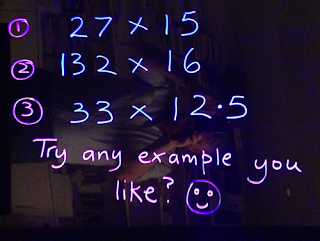


The above examples were put on the board and partners were told that they could select the one that they wanted to try. Many students moved onto the two harder ones immediately and had no difficulty realising that there boxes would be needed for three digits not 2 as before.

The lesson went too fast and was too much fun. When I asked the students why they thought I was mean enough to put the multiplication on the board without explaining it to them, comments such as the following were made:

“Because you wanted to see what we could do without teacher help.”
“Because you wanted us to feel proud and successful.”
“Because you know we learn better when we explain for ourselves.”
“Because you wanted us to have fun working with a partner.”

I asked the class to give a thumbs up if they thought they learnt better without a teacher demonstration than they would have done if I had demonstrated and given them lots of examples to practice on. Their response was a resounding thumbs up.

Last year I was thinking a lot about Carole Dweck’s work around fixed mindset and growth mindset. It is my belief that because:

  • The tasks that I set students are challenging 
  • I expect them to work together 
  • There are no winners or losers and struggle 
  • Sharing is the norm.

I am seeing less and less fixed mindset even in those students who used to perceive themselves as good at maths and stick with the safe methods.

Next year I intend to push this even further and try to say even less than I did this year. I am also coming to the conclusion that a lot of teacher questioning is really just telling and playing ‘guess what’s in teachers’ minds, and, what is more, it interferes totally with the students’ thinking. Student questions are so much more interesting to them and to me and they usually lead to learning that they are ready for.

Tuesday, 10 December 2013

Making maths fun with Pop Beads

I was out shopping when I came across these pop beads.


Pop went my brain too – bringing maths and ‘The Brain likes Colour’ to mind.

You see, I am working on a Place Value to 100 and Beyond package at the moment in which one of the central themes is purposeful counting. Purposeful counting of large collections is a sure fire way for students to begin to see why we need speed counting (skip counting, if you prefer) as well as why organising in 10s makes sense. These little pop beads have 170 in a packet, plenty to share and to count and sort.

Make 50

My first game idea for two players was a collaborative one (which you can differentiate by changing the target number to suit the players). On their turn players dip into a paper bag and take a handful of pop beads. They set them out to see how many they have taken.

The next player then decides whether to take a small handful or a large handful because the aim of the game is to have 50 pop beads by the end of exactly six rounds. Players confer, and may use a 100 square to help them plan their next ‘take’. It might well be that for the last three goes players take only one pop bead but that is fine. Over time and through discussions about counting on from any starting number by 10 the ‘takes’ should become more evenly distributed. In fact you might invent a rule that says you may not take a single pop bead or even as few as two.

Of course you could do this activity with other materials but I am looking for an excuse to go shopping for appealing, unusual and very colourful maths resources that don’t break the classroom budget. If you find exciting cheap colourful and safe items, please add to the list. Let’s get stocked up for next year!

Thursday, 5 December 2013

The brain likes colour

Back from England, refreshed and ready to go. I’m now wondering what supplies and ideas I can play with next year.

In an earlier post, I talked about how maths can sometimes be presented in a dull and grey way. We know the brain likes colour so why not include more colour in the maths lesson? One thing led to another and I began to think about a supplies list for maths next year.

Top of the list: coloured paper and mark making equipment. Checkout the piece below and you will begin to see that hole punches and glue sticks might be fun too.

Also on the list, brilliant picture books, even with older students. The butterfly was triggered by, 'Lots of Spots' by Lois Ehlert. I have written to her to ask if I can create and publish some activities based on this book.

As I looked at the book, the combination of fun, colour and  maths  jumped out at me (yes I know this is not a maths book!). I was seeing symmetry, subitising, counting, comparing, estimating and fractions with mental computation strategies all in just a flick through.

Then of course I had to play. I folded a piece of paper in half and drew a butterfly. Then I punched some holes. Before opening it I used a doubles fact to work out how many holes I would see. I also visualised roughly what the butterfly would look like when I opened it up. Then the moment I opened it and looked at it, I thought it was a bit boring so punched out some holes in a different colour and placed them carefully so that the line of symmetry was not disturbed.


As I looked, I couldn’t help but wonder what fraction of the spots were yellow. But there was still something missing...

We know we need to make connections between mathematical ideas and to consider the ways in which different aspects of maths are related. This little exercise crossed many normally atomised areas of the maths curriculum into one fun but rigorous activity. It links visual imagery, symmetry, fractions, halving and doubling for number facts and estimation as well as subitisation into one easy to differentiate activity.

Let me know what you think and if you try it with your class. We’d love to see pictures, which you can send to Sarah.


'Lots of Spots' by Lois Ehlert

Thursday, 28 November 2013

Teaching problem solving strategies - achieving great outcomes

Having a sound understanding of maths is important from childhood through to adulthood. However, a lot of adults frown with confusion when presented with a problem solving situation. Memories of their school days trigger feelings of failure, lack of resilience ‘this is too hard’ and lack of executive planning function in terms of being able to find a way through and finding the steps required to solve the problem. 

We can do better than that for our students. 

We can use the STAR model explicitly, to help them sort out what the problem is about, what info they need to use, what the problem is asking them to find out and what the answer of the problem will actually tell them. We can then make it explicit to the students the thought and planning processes required to be able to get started on the problem. We ask “have we done a problem like this before?”, “what kind of problem is it”, “do I need to draw a table or work backwards, spot a pattern?” – these are questions we can encourage students to ask during this incubation time. 

If the ‘S’ and ‘T’ are well done, than action will follow fairly smoothly. Reflection is the crucial step where we can ask students what worked and what didn't work and what they can use if a similar problem was to come up again. Students can’t tackle the ‘think about it stage’ particularly well if they hadn't had earlier problem solving experiences where they have learnt how to apply strategies such as draw a picture, act it out, spot a pattern, select an operation, and so on. 

Structuring problem solving experiences with all of these steps in mind will ensure students have a positive disposition to problem solving as well as a well-equipped tool box to choose from. 


Tuesday, 19 November 2013

Contextualised maths problems: Santa's cooking gift sets

When it comes to teaching, there's nothing  more satisfying than seeing students get excited about maths as it finally 'clicks' for them. We're all to aware that each student has a different understanding and appreciation of maths. Therefore, it's important we teachers provide different entry points that allow each student to find their own way into a problem and use their own strategies. We need to promote that's it's not a race to the answer, rather they should take the time to think about what they have done before that may help them (our STAR model is handy here) and take risks to develop strategies that suit them.

Using problems that have context that is meaningful to them (so they can to relate to it) is a great way to further engage the students. So here it is, a problem with a Christmas theme:

Father Christmas was testing his favourite recipe while his elves were busy packing childrens' gift sets that Santa promises will have every child cooking up a storm in no time! Each set has 3 knives, 2 wooden spoons, a cutting board, a mini mixer, an apron and of course a Santa cook book, 'Santa's recipes made easy'. 

“Make me 15 sets right away and be quick.” Santa told the elves between mouthfuls of tender, tasty turkey.


The elves groaned: “That is a lot of sorting and packing!”

How many items do the elves have to pack into each set?

How many items will the elves have to collect from the shelves?

We'd love for you to share the results on Facebook: Natural Maths Facebook page

make connection between mathematical ideas and maths and how it’s used in the real world.

Tuesday, 12 November 2013

Reindeer Numbers


We delivered Christmas maths problems for earlier grades in a previous blog post recently, and now here's one for upper primary. 

This one will really get the studnets things:

One of Santa's best kept secrets is that there is a special link between a reindeer and its number. Indeed, a reindeer number has the property that it is equal to the product of two of the numbers (known as antlers) that can be made with its digits. For example, 1827 is a reindeer number with antlers equal to 21 and 87, because 1827 = 21 × 87. Sometimes one of the antlers gets broken (i.e. is 1 out) like
3456 which is the number of a reindeer with a broken antler:

3456 = 64 × 54 and just one digit is 1 out.

On the night before Xmas, the reindeers with these reindeer numbers reported for duty:

1827 2187 1435 3456
1932 2496 6880 8190
1530 3864 1395 7189

"It's wonderful to see you all," Santa said... "but I can only use reindeers whose antlers are not broken. It's a long journey, and you will need all the antler power that you can get if we are to deliver all the presents."

Ask students to help Santa sort out which of the reindeers he can use to pull his sleigh.

"Now, where is my friend Rudolf?" Santa said. "I can't go without him!" Rudolf has the smallest reindeer number and a complete set of antlers, but he hasn't reported for duty yet. What reindeer number should Santa go looking for if he is to find Rudolf?

There will be loads more Christmas themed problems to come that we'll share via our blog in the lead up to Christmas so stay tuned. 


Thursday, 7 November 2013

Helping students gain a positive appreciation for maths


I'm often asked which key topics teachers can pay special attention to when it comes to maths. Students need to develop a strong numbers sense from an early age built on understanding of quantity.

They need to be able to pull numbers apart in many different ways so they can engage in value based not digit based mental computation strategies. From year four, students really need to have a deep understanding of fractions based on multiplicative strategies not additive strategies.

From the early years, notions of proportional reasoning need to be informally developed so that by year six students have an understanding of proportional reasoning and multiplicative reasoning.

You've heard us say it before, but we'll say it again: you can help students gain a positive appreciation for maths by giving them time to really think about a problem.

If we build on students’ earlier intuitive thinking, we can ensure all students like maths and are successful. Avoid 'rescuing' students and treating maths like it’s a race - trying to cover the curriculum rather than developing a deep understanding. Later maths is built on earlier mathematically building blocks. Enable the students to develop a good foundation and the rest will follow.

Friday, 1 November 2013

Maths problems using Christmas fun

While Christmas is a little while away, it will be here before we know it. So we'll share some of our favourite maths problems - combining maths and Christmas that will certainly get the students equally enthused about the two topics. These are for grades 1 and 2 - we'll share problems for higher grades throughout the month so stay tuned.

Whizzing Yoyos
Mrs White wants to give every one of the 20 children in her class a whizzing yoyo for the Christmas
yoyo trick competition but she doesn’t know how many packets of yoyos to buy.


There are 4 whizzing yoyos in a packet and each packet costs $5. How much will it cost her to buy
the yoyos?

Lucky Dip
Mrs White bought 6 bags of lucky dip prizes and found that there were 4 prizes in each bag. She
wants to share the toys fairly into three lucky dip barrels.

How many toys should she put into each barrel?

Secret Santa
I need to buy 12 Christmas cards for the secret Santa we are having in the staff room and I was wondering which will be cheaper, buying cards in packets of 2 for $5,or packets of 3 cards for $6.60. Oh I just noticed that the packets of 6 glitter cards for $18 are marked down $3.

Which cards should I buy?

Xmas Muffins
I found this decorated Christmas muffin recipe. It says that for 6 muffins you need 36 stars, 18
walnuts and 12 silver balls.

I want to make 24 muffins though. So how many stars, walnuts and silver balls will I need to decorate the tops with?
Santa’s Reindeers
Santa’s nine reindeers are ready to be harnessed to his sleigh.

The leading reindeer is on his own and after that they are harnessed in 2 lines of 4, making 4 rows of 2. But where should they be placed?

Reindeers with the same initial quarrel so badly that there has to at least one row of other reindeers between them. These reindeers are also arranged alphabetically, front to back.


In each row, the reindeers are arranged alphabetically left to right. For example, Prancer would be to the left of Rudolf if they were in the same row, which they are not, and Prancer would be to the right of Comet if they were in the same row, which they are not. The reindeers that come first and last alphabetically are such close friends that they have to be in a row together.


Monday, 28 October 2013

The Rainbow Fish

Ann was  recently at Frenchville Primary School where she noticed a display based on the Rainbow Fish by Marcus Pfister, one of her favourite series of books.

The  following photograph shows the whole display but look closely at the next photo and you will see that the  scales on each fish are made from fractions of cup cake papers.

How many cup cakes wrappers were needed to make each fish Ann wondered.

The Problem
(Note the first  picture to follow has  scales that are ¼ of the paper and the second photo of scales shows scales that are 1/6  of the paper, select to match your learners.)


My friend, the year 1 teacher, has to buy cup cake papers in green, blue, red, pink, yellow, and silver so that her class can each make a fraction  rainbow fish. Each scale is the same size fraction and each fish will be the same. She  has 23 students in her class.

How many  cup cake papers will she need?

Note: John Van de Walle suggested that students should be encouraged to look at a fraction and visualise the whole from which it was taken so that they could work out what fraction is shown. With this in mind  encourage your students to identify and explain what fraction of the whole they think the scales are before they begin work. Select the class or group size to match the range of your students.

Monday, 21 October 2013

The Spider Party

A couple of weeks ago we showed the Jelly Bean problem from Kathy Lanthois’s Year 7 class and promised more. Well here is the class Spider Party Problem.


Kathy’s class researched the best and most economical spider drinks for the spider party that they were actually going to have. 

Note: this is important. The Spider Party was a real problem not a Mickey Mouse ‘let’s pretend we going to have a party’ problem or even and Ann Baker true story. It took several days of working with surveys and taste tests, proportional reasoning, measuring and costing before the final tightly-budgeted spider-making day. The above work sample is just one of those displayed on the classroom wall. And yes of course the spider party was a huge success and the mathematics located the Spider Drink flavours that meant everyone had the spider they liked the most.


With Halloween just around the corner, Spider Parties must surely be a winner with any class!

Friday, 18 October 2013

A Halloween Problem

Ann was running a demo lesson with the year 3s at Crestmead Primary School this week. Ann told the class that she wanted to make 12 trick or treat bags for a Halloween party but didn’t know what to put in them. The students were quick to identify the quintessential ingredients for the bags. The problem that emerged is shown below along with a few student samples that demonstrate a wide range of strategies.

12 bags

Each bag will have:
6 sour worms
2 sets of vampire teeth
5 bubble gums
4 jelly snakes
10 mini- marshmallows
3 lolly pops
13 little chocolates
How many of each type of sweets will that be?
How many sweets will that be to fill the bags altogether?

Student Work

This problem had just the right amount of desirable difficulty for the class who were engaged readily and who persisted with the problem solving process. As is usual with these problems there was a broad range of approaches allowing students multiple entry points into the problem.

Not all students answered all parts of the problem as can be seen in Hayden’s work sample. Hayden however demonstrated that he had interpreted the problem as a multiplicative situation and linked the multiplications to two different representational forms for multiplication. He is developing a firm foundation for connecting these strategies to the more formal strategies of multiplication. You can also see that Hayden was applying fix up strategies as he worked.


Roania’ work sample shows that she is able to use known multiplication facts flexibly. She has used the distributive property to split 12 into 10 and 2 because she ‘knows her 10s and knows how to double’. The realism of the problem connected to her and is manifested by her idea of presenting each type of sweet in its own box so that it could be used as a shopping list.


Roma’s strategy though not fully correct or complete (she was working on her fix up strategy when time eluded her) focussed on the second question rather than the individual parts. She worked out 43 sweets in each bag and began to carry out a repeated addition with chunking. As she began chunking her answers, place value problems became visible. As formative assessment these types of problematised situations make visible gaps and error patterns that might otherwise go over looked.


The following work sample shows how one student checked the reasonableness of his answers, giving ticks before moving onto the second question, how many altogether. As a work sample that shows the working out and steps involved this one really makes the student’s thinking visible.


And last, the next sample shows counting in 2s, 3s and 5s as well as the use of tallies, with the totals being rearranged to make good use of friendly numbers.


Over all the samples give a snap shot of the range of strategies and levels of development that can be seen in any class. We’d like to say thank you to this class and the teachers involved. The students were AWESOME.

Friday, 11 October 2013

Metric Measurement Week

This week is National Metric Week in America where despite the fact that they still use Imperial measures such as feet and inches, there are some people who think that metric measures are the way to go. One thing led to another and the next thing we were discussing the developmental sequence that leads to deep understanding of linear measurement. As we were talking about that we decided to blog about our Linear Measurement Series, Books1, 2 and 3 which we researched, trialled in classrooms and produced in response to the poor attempts at the standardised test question that required students to mark the bubble that said how long the given line was. Right next to the line and correctly aligned was a broken ruler. Most students shaded the 9 cm bubble but the correct answer was 5 cm. That is almost twice the length. How come students: 
  • could not measure with a broken ruler and 
  • (perhaps more importantly) didn’t have any kind of visual spatial alarm bells going off in their heads telling them that no way was the line 9 cm.

From the research that we looked at it became clear that teachers needed more guidance about how to teach linear measurement than their basic training provided. The Linear Measurement books ensure that students have worthwhile experiences (no one in real life measures lines on a page for a living) and that those experiences should include: iteration, transitivity, conservation and estimation skills.

A developmental sequence


Each of the books has a Top 5 that explains exactly what aspect of linear measurement is being developed. The activities in the books are focussed on the Top 5 and, as an example, here is Activity 8 which focuses on the estimation concepts that are part of the above Top 5.

Using technology to teach measurement

The Three Snakes measurement app also grew out of this research. The app focuses on looking at the starting point and the finishing point when making comparisons. Often students only look at the end point as with the standardised test mentioned earlier. The Three Snakes app also provides opportunities for students to apply reasoning skills to comparison problems focussing on the comparative language of measurement, short, shorter, shortest, long, longer, longest.

Wednesday, 9 October 2013

Showcasing South Australian Teachers

Ann is really enjoying her work with South Australian teachers. Recently Kathy Lanthois of Darlington Primary School invited Ann into her Year 7 classroom to see what her class had been up to in maths. What a term her class must have had and no wonder her students look forward to maths so much. Today we are showcasing her Jelly Bean project. Her class had been learning about fractions, decimals and percents and so, to see what they had learned and could apply, the Jelly Bean Maths activity was set up.

Each group was given a packet of Jelly Beans to investigate. Their mission was to find out about the distribution of colours in a packet and also to research favourite colours with a goal of informing the manufacturer of their findings and recommendations. The hidden agenda of course was to find out how and whether the students would apply their new understanding of decimals and percents. What a great formative and/or summative assessment task!


The following work sample was one of many showcased on the classroom wall. Sorry we only have one photo - should have taken loads.


It shows, as did the others, that the students worked out what fraction, decimal and percent of the packet each colour represented. They could translate between those forms and offer explanations of their thinking.
We love the free form layout, all different, the use of colour and details that personalise the maths on each poster. Can we start a BAN THE GREY, BORING, MATHS movement? Maybe then there would be fewer disengaged maths students around.

Watch this space for more exciting maths from this class.