Friday, 17 January 2014

Schools Clean Up Day: Friday 28th February 2014

We all know students learn better when we can help them to make connections between in school activities and out of school current events. So let’s live greener by participating fully in Clean Up Australia Day.

A free kit with plenty of lesson plans and ideas is available for free at the Clean Up for Schools website.

There is plenty of stimulus for connected maths and science to be found at this site.

Way back in 1991 Johnny and I wrote a book called Counting on a Small Planet.

We were then and still are committed to doing whatever we can to preserve our environment. One section of the book was called ‘What’s in a Lunch Box’ and we have included a segment from it below. We used a real problem solving model with the class who worked over a period of several days on this problem.

What was not included in the book was the fact that this particular class decided to host a no rubbish morning tea for their parents. They discovered that in the ‘old days’ people took their lunch to school or work wrapped in handkerchiefs or tea towels and that workers took their own tea and coffee in a flask with their own cup.

They also discovered that Cornish pasties had sweet at one end and savoury in the middle and that the pastry was its own container. A lot of planning, problem solving and mathematics went into the morning tea. What a great way to raise parent’s awareness and for them to see how passionate their children were about the ‘rubbish’ issue.

With the event happening in February, it's never too early to start thinking about what else we can do to help children gain a better understanding of environmentally friendly practices that also tie in with learning, in particular maths learning.


Monday, 13 January 2014

Place Value to 100 will be available next week

Working in classrooms, we often notice areas that cause students particular difficulty. One of those areas is place value. We meet students even in Grade 4 who are doing 2-digit and 3-digit additions and, when asked, cannot read the answer correctly, nor do they have any idea if their answer is in the ball park.

Recently a Grade 4 boy was solving a problem using dots as counters, he got to 69 looked up and asked, ‘What comes after 69?’. When prompted, he continued the pattern until he reached 79, and then looked up for help again. Similarly when trying to teach students to use number splitting for value-based computations we meet students who know that the 2 in 27 means 20 but think that the 1 in 12 is just 1 not 10.

Clearly we are moving forward too fast with place value. Much research is suggesting that place value is an issue even in Grade 7.

So what goes wrong?

That was the question that we have been grappling with for quite some time. If students cannot actually count and count on in different patterns, how can they understand the role of digits in 2-digit and 3-digit numbers?

If they have not had experiences making single digit numbers in lots of different ways, how can they then understand that a number such as 36 can be made with three 10s and six 1s or with two 10s and sixteen 1s.

Difficulty with teen numbers is known to persist into Grade 4 - why then have we not paid more attention to developing deep understanding of teen numbers? Why do we rush when 'slowly slowly' wins the race?

The new package focuses on purposeful counting; understanding the magnitude of numbers to 100; sequencing numbers proportionally on an empty number line and solving problems requiring that numbers be grappled with, pulled apart put back together in many ways. Quantification and number sense are the driving forces used to build deep understanding of place value.

We hope you enjoy the package. Watch out over the next few days as videos of the place value games will be released.


Have a great year. Week Zero in South Australia next week and we are really excited to be in Adelaide next week working with teachers and yes you guessed it, showing off our new resources.

Monday, 6 January 2014

3D blocks for mental routines

Like everybody else, we are tidying up and planning for next year. As we did so, we came across the following email from Ann Paine. We don’t know how we missed it earlier but we thought we would post it so that you can get inspired by her 3D objects set too.

Hi Ann,
After your Spacial Awareness training session, I was inspired to make up these 3D Objects Mental Routine kits. One of the parents at my school made the cones using plasticine. I made the pyramids from card. My class enjoyed using the kits. As usual, they love to guess my 3D object at the end of the mental routine.
Feel free to share this idea.
Anna Pain
Light Pass Primary School.


EngQuest new in 2014

STEM Education (Science, Technology, Engineering, Mathematics) is gaining ground in schools. Many future jobs, some not even invented yet, will demand high levels of understanding and skill in STEM fields.

Natural Maths is embracing STEM and will be flagging existing problems and activities that relate to STEM as well as designing specific problems and activities to promote STEM.

Did you know that February launches the 2014 EngQuest?

EngQuest is a challenge from Engineering Australia designed to be hands on and cross curricula.
Two challenges, simple machines and water wheels, are already outlined on their website and both have a suite of support materials. Registration to EngQuest is free and there is a free support pack available from Engineers Australia at http://www.forteachersforstudents.com.au/Events/engquest.php

Go take a look and get ready for the best school year ever.

Saturday, 28 December 2013

Bringing my learning from 2013 into 2014

Yes life is a little quieter at the moment and it is time to reflect on 2013. What worked, what didn’t and why? It is also time for me to be planning for the massive year ahead.

A large part of my professional development work next year will revolve around pedagogical moves in the maths class. During 2013, I tried out a few ‘moves’ one of which I call:

‘Do next to nothing’.

That sounds lazy but let me tell you it is hard work and it takes bravery and careful planning. So what do I mean?

In October, I wrote about the ratio and a pizza problem I gave to a Year 7 class at Mawson Lakes Primary School in Adelaide. The class had never done ratio and the fraction part was quite tough too. The students were asked to work with a partner. They were to listen to each other try to make sense of the problem and then explore ways of solving it. The main rule was that both partners must clarify their thinking and be able to explain the work that they did. They were also told that there would be no teacher assistance (even though there were 12 of us in the room).

After 10 minutes of agony, all sorts of incredible thinking and trial and error and a wide range of strategies were being trialled and the results showed that students could actually talk their way into an understanding of ratio and fractions.

Another example of ‘do next to nothing’ was a strategy lesson with Year 4-5 class at John Hartley Primary School. The Australian Curriculum Mathematics suggests the use of the area model for multiplication. I decided to put a worked example up on the board and again use partners with the rules outlined above.

I put the following worked example on the board and told the students that they had as much time as they needed to work together to find out how the model I had drawn worked and why. This was their first introduction to the area model. Initially there was stunned silence and then some ‘light bulb’ moments.


This was when the next pedagogical move kicked in:

‘Get the students to do the teaching and explaining’

Partners were asked to volunteer to come up to the board and explain one step at a time. The remaining students gave thumbs up, thumbs on the side or thumbs down to le t the volunteers know if they had understood the step.

A second partially complete example was put up and the process repeated. A few students who had struggled with the first example were now feeling secure enough to volunteer to explain a step.
As we listened to the students working together we gained many windows into student thinking, which included some place value issues. – 26 was easily partitioned into 20 + 6 but 15 was partitioned into 1 + 5 by a few students. This was soon rectified by listening to and questioning the volunteers.
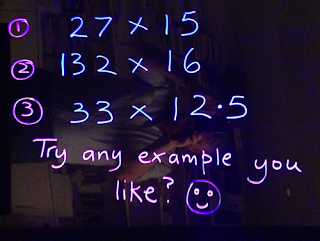


The above examples were put on the board and partners were told that they could select the one that they wanted to try. Many students moved onto the two harder ones immediately and had no difficulty realising that there boxes would be needed for three digits not 2 as before.

The lesson went too fast and was too much fun. When I asked the students why they thought I was mean enough to put the multiplication on the board without explaining it to them, comments such as the following were made:

“Because you wanted to see what we could do without teacher help.”
“Because you wanted us to feel proud and successful.”
“Because you know we learn better when we explain for ourselves.”
“Because you wanted us to have fun working with a partner.”

I asked the class to give a thumbs up if they thought they learnt better without a teacher demonstration than they would have done if I had demonstrated and given them lots of examples to practice on. Their response was a resounding thumbs up.

Last year I was thinking a lot about Carole Dweck’s work around fixed mindset and growth mindset. It is my belief that because:

  • The tasks that I set students are challenging 
  • I expect them to work together 
  • There are no winners or losers and struggle 
  • Sharing is the norm.

I am seeing less and less fixed mindset even in those students who used to perceive themselves as good at maths and stick with the safe methods.

Next year I intend to push this even further and try to say even less than I did this year. I am also coming to the conclusion that a lot of teacher questioning is really just telling and playing ‘guess what’s in teachers’ minds, and, what is more, it interferes totally with the students’ thinking. Student questions are so much more interesting to them and to me and they usually lead to learning that they are ready for.

Tuesday, 10 December 2013

Making maths fun with Pop Beads

I was out shopping when I came across these pop beads.


Pop went my brain too – bringing maths and ‘The Brain likes Colour’ to mind.

You see, I am working on a Place Value to 100 and Beyond package at the moment in which one of the central themes is purposeful counting. Purposeful counting of large collections is a sure fire way for students to begin to see why we need speed counting (skip counting, if you prefer) as well as why organising in 10s makes sense. These little pop beads have 170 in a packet, plenty to share and to count and sort.

Make 50

My first game idea for two players was a collaborative one (which you can differentiate by changing the target number to suit the players). On their turn players dip into a paper bag and take a handful of pop beads. They set them out to see how many they have taken.

The next player then decides whether to take a small handful or a large handful because the aim of the game is to have 50 pop beads by the end of exactly six rounds. Players confer, and may use a 100 square to help them plan their next ‘take’. It might well be that for the last three goes players take only one pop bead but that is fine. Over time and through discussions about counting on from any starting number by 10 the ‘takes’ should become more evenly distributed. In fact you might invent a rule that says you may not take a single pop bead or even as few as two.

Of course you could do this activity with other materials but I am looking for an excuse to go shopping for appealing, unusual and very colourful maths resources that don’t break the classroom budget. If you find exciting cheap colourful and safe items, please add to the list. Let’s get stocked up for next year!

Thursday, 5 December 2013

The brain likes colour

Back from England, refreshed and ready to go. I’m now wondering what supplies and ideas I can play with next year.

In an earlier post, I talked about how maths can sometimes be presented in a dull and grey way. We know the brain likes colour so why not include more colour in the maths lesson? One thing led to another and I began to think about a supplies list for maths next year.

Top of the list: coloured paper and mark making equipment. Checkout the piece below and you will begin to see that hole punches and glue sticks might be fun too.

Also on the list, brilliant picture books, even with older students. The butterfly was triggered by, 'Lots of Spots' by Lois Ehlert. I have written to her to ask if I can create and publish some activities based on this book.

As I looked at the book, the combination of fun, colour and  maths  jumped out at me (yes I know this is not a maths book!). I was seeing symmetry, subitising, counting, comparing, estimating and fractions with mental computation strategies all in just a flick through.

Then of course I had to play. I folded a piece of paper in half and drew a butterfly. Then I punched some holes. Before opening it I used a doubles fact to work out how many holes I would see. I also visualised roughly what the butterfly would look like when I opened it up. Then the moment I opened it and looked at it, I thought it was a bit boring so punched out some holes in a different colour and placed them carefully so that the line of symmetry was not disturbed.


As I looked, I couldn’t help but wonder what fraction of the spots were yellow. But there was still something missing...

We know we need to make connections between mathematical ideas and to consider the ways in which different aspects of maths are related. This little exercise crossed many normally atomised areas of the maths curriculum into one fun but rigorous activity. It links visual imagery, symmetry, fractions, halving and doubling for number facts and estimation as well as subitisation into one easy to differentiate activity.

Let me know what you think and if you try it with your class. We’d love to see pictures, which you can send to Sarah.


'Lots of Spots' by Lois Ehlert